- July 16, 2026
- 2:16 pm
If You Want to Start an HVAC Business in 2025, Watch This Interview (With a 7-Figure HVAC Biz Owner)
Table of Contents
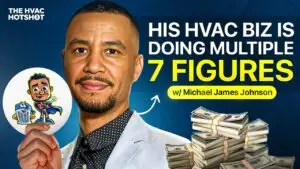
Mike, the Air Force veteran behind AC Man Heating and Air, built a 20-year company from the trunk of a car in Jacksonville, North Carolina. In this episode of HVAC Hotshots, he breaks down the $40 pricing course that changed his entire business, why he shut off $4,000 in monthly Google Ads to post social content 40 times a week instead, and the automated text system that drives over 90% response rates from his customer base.
Introduction
Mike spent years working every day and not making money. Not because he lacked customers. Not because his work was poor. Because his pricing was wrong and he did not know it yet. It took a $40 course in Wilmington, North Carolina to fix what years of hard work could not.
Mike is the founder and owner of AC Man Heating and Air, a 20-year HVAC company in Jacksonville, North Carolina, home to one of the largest Marine Corps installations in the country. He started the business in 2004 from the trunk of his car, six years out of the United States Air Force, with no customer base and no inherited business to draw from. Today the company holds 800+ five-star Google reviews, runs automated text campaigns with over 90% response rates, and posts across social media 40 times per week using AI to produce the volume without producing 40 separate recordings.
This episode of HVAC Hotshots covers what it actually takes to build something that lasts in this industry: the pricing foundation, the marketing system that replaced paid ads, and the customer retention strategy that keeps homeowners from forgetting who you are. Keep reading.
From the Air Force to the Trunk of a Car
Mike did not plan on owning an HVAC company. He served six years in the United States Air Force, working on generators, aircraft equipment, and heating and air systems across 300 different types of machinery. When his service ended, he enrolled in a two-year HVAC tech program to translate military-grade technical training into residential and commercial knowledge.
He never finished. Midway through his second year, sitting in a summer classroom while his bills went unpaid, he stood up and walked out. He drove to his first service call. That was 2004.
He started AC Man from the trunk of his car, alone, with no customer base and nothing to inherit. He had the technical skills. What he did not have was a business.
“I could fix air conditioners,” he said, “but there’s a whole business behind having a business. It’s not just oh hey I have these tools, I have this knowledge, I’m going to go out there and crush it.”
Twenty years later, AC Man operates in a market defined by its military community. The company is veteran-owned, which is not just a USP. It is a genuine connection to the people Mike has served alongside. When he talks to a customer who has been stationed at Camp Lejeune, he is not doing a pitch. He is talking to someone who understands exactly what his six years meant.
That context shapes everything about how the business operates: the hero-themed brand identity, the nonprofit partnerships, the consistency of showing up as a person in the community rather than as a logo on a Google ad. Mike built the company in his own image, and that turned out to be the strategy.
The $40 Course That Fixed What Hard Work Couldn't
The fastest way to destroy an HVAC business while working every single day is to price jobs based on what you think they should cost, or what you hear competitors are charging. Neither number has anything to do with your actual cost structure or your actual profit goals.
Mike learned this the hard way. For several years after starting AC Man, he ran calls, did good work, and watched his bank account stay flat. “You can work really really hard and not make money,” he said. Athletes play every game as hard as possible and still lose. Working harder was not the problem. The underlying math was wrong.
Then he drove an hour and a half to Wilmington, sat through a pricing course, and paid $40 for the answer. “Everything changed from there.” The price of a job is not a guess. It is an output of your costs and your goals. What a competitor charges means nothing if that competitor is also going out of business.
That realization is now the foundation of everything Mike teaches through Sales Elite, the sales training company he runs alongside AC Man. The program offers one-on-one Zoom coaching for HVAC sales teams, pricing courses, and technician training, built from two decades of running calls himself. He created it specifically because pricing ignorance was the gap that stalled his own growth for years and he sees it stall operators every day.
When to Bring in Outside Help on Pricing and Business Fundamentals
If your revenue is climbing but your profit is not following, the problem is structural. Pricing, overhead, and cost allocation decisions made early in a business tend to calcify. They stop being revisited even as the business grows. The fix is rarely working harder. It is working through the numbers with someone who has already been through them.
A TradeOps strategy call is built for exactly this inflection point. Book yours here.
For operators looking to build a digital presence that supports a properly priced business, SEO services for HVAC companies generate returns that depend entirely on the unit economics behind each booked job being healthy.
Why Mike Quit Google Ads and Posts 40 Times a Week Instead
In January 2024, Mike shut off all Google Ads for AC Man Heating and Air. He had been running a $4,000 monthly budget. “We would go through a $4,000 budget like boom, gone,” he said. “No leads, no nothing.”
That money did not move to a different ad platform. It moved to two things: volume content on social media and community outreach through nonprofit partnerships.
The social media system is built around volume, not production cost. AC Man posts 40 times per week across platforms. That output does not require 40 separate recordings. Mike feeds one 10-minute video into an AI tool that generates 37 individual clips, each formatted and trimmed differently for different placements. The content goes across Facebook, Instagram, YouTube, and more. The result: more consistent brand visibility than $4,000 a month in Google spend ever produced.
The outreach strategy runs alongside it. AC Man partners with nonprofits the team genuinely believes in, including the Tulsa Initiative, which works with young men in the community. When they show up to support a nonprofit, they show up as the business. The events get filmed, and the footage gets distributed everywhere.
Mike is transparent about why this matters operationally: “The more that outreach as a business brings in leads and brings in customers, the more money you have to give back to that nonprofit.” Showing up anonymously is admirable. Showing up as the business, filming it, and posting it creates a marketing cycle where the charitable work and the customer acquisition reinforce each other. The nonprofit benefits from the distribution. AC Man builds community trust that no paid ad can replicate.
For operators who want paid social to work alongside an organic content strategy, Facebook ads for HVAC companies produce the best returns when the brand already exists in the audience’s awareness before the ad appears.
The Text and Email System Driving 90% Response Rates
Text messages get read. That is the single most operationally important fact in Mike’s entire marketing system.
Industry research confirms it. SMS open rates consistently run in the 95 to 98% range, with most messages read within minutes of delivery, compared to general email marketing averages of 20 to 28%. Response rates on SMS campaigns average 45% across industries. Mike’s numbers at AC Man run ahead of those baselines: over 90% response rate on texts, and a 50% email open rate that outperforms industry averages significantly.
The reason his email rate is that high is segmentation. His 4,000-person customer database is not one list. It is many. Realtors only. New installs from this year. New installs from last year. Customers who have not contacted the business in two years. Maintenance plan members. When a campaign goes out, it goes to the right segment with the right message.
This month’s Realtor email carried a tip about moisture issues affecting homes they are selling. The same list base received a different version with a different angle. Each group got content written for them. A 50% open rate is what happens when people receive emails that are actually relevant to them instead of a blast that applies to no one in particular.
The software stack making this work: Housecall Pro for scheduling and CRM, Chirp for automated text campaigns. Every booked job triggers an instant confirmation text. A reminder goes out the morning before. A follow-up campaign runs automatically at six, twelve, eighteen, and twenty-four months after the last service. Cancellations dropped when that sequence went live. Customers had simply forgotten the appointment was scheduled.
Mike described automated texting as the single biggest operational shift the business made.
The maintenance plan sits underneath all of this as the foundation. Without service agreements, customers drift. “If you ask people to name the HVAC company that you used last year,” Mike said, “people don’t remember.” When the unit fails again, they search. You start over from zero. Recurring revenue through maintenance plans keeps AC Man present in the customer’s life between service calls, and the text campaigns keep the relationship active month to month.
Lead generation for HVAC companies built on retention produces compounding returns. A customer retained is a customer who does not need to be re-acquired.
How AC Man Builds a Company Worth 20 Years of Trust
AC Man’s competitive position in Jacksonville is built on things that new entrants cannot shortcut. Twenty years in business. Eight hundred-plus five-star Google reviews. A veteran-owned identity that connects directly to the community it serves. None of those are achievable in year one. All of them are the result of decisions made consistently across two decades.
The Hero Promise structures how the company shows up in every interaction: honor the customer’s time, commit to doing the job right the first time, stay reliable, and give back through community outreach. These are operating standards, not wall art.
Hiring to that standard starts before any technical evaluation. Mike hires for personality first, skill second. “I can train you how to fix a machine,” he said. “I can’t make you a good person. So we hire for personality, not for skill.” Employee referrals are the preferred sourcing channel because strong employees refer people who are like themselves. The result is a team that shows up on time, communicates when something changes, and represents the company correctly on every job site.
When a negative review lands, the process is written down and followed without exception. Step one: close the computer and wait at least an hour before responding, because the immediate reaction will not be a rational one. Step two: call the customer directly. Do not respond publicly to the review. Listen without defending. Let them feel heard, because most negative reviews are left by customers who tried to tell someone and were not listened to. Step three: go in person if the situation allows. Step four: after resolving the issue, ask them to update the review. Step five: write down whatever caused the failure and create a process so it cannot recur.
“I’ve had many people change one-star reviews to five-star reviews doing that,” Mike said, “because I accepted the feedback.”
The slow season gets handled with the same level of preparation. Mike’s text and email campaigns are fully written and scheduled before slow season begins. “Mine’s already planned,” he said in August. “It’s not slow. All my text message campaigns are already written and ready. They’re like a dog at the fence waiting for the fence to open.” Technicians are trained to reframe the slower call volume: fewer calls mean more time to dig into systems, find problems that will cause failures next summer, and fix them now. That approach is better for the customer and generates additional ticket revenue during the period most operators just wait out.
Conclusion
Three things define how AC Man has built 20 years of business that still runs on referrals, reputation, and recurring revenue.
Pricing is not a guess. It is a calculation built on your actual costs and your actual goals. Every operator who skips this step works hard and wonders why the money does not follow.
Marketing is volume and relevance, not budget. Forty segmented texts and posts a week built more visibility than $4,000 a month in Google Ads ever did. The channel matters less than the consistency and the targeting behind it.
Trust is a system. The same negative review process, the same hiring standard applied to every candidate, the same text reminder sent at twelve months and again at eighteen: none of those are instincts. They are written processes, run repeatedly, that compound over time into something competitors cannot copy quickly.
To work through what any of this looks like applied to your business specifically, book a free TradeOps strategy call. Subscribe to HVAC Hotshots wherever you listen to podcasts for more conversations like this one.
FAQ
If you are running a full schedule but your profit at the end of the month does not reflect the volume you are doing, your pricing is almost certainly wrong. The calculation has to be based on your specific costs and profit goals, not what competitors charge. A structured pricing course or coach can identify the gap in a single session.
It depends entirely on management quality and market conditions. Mike ran $4,000 a month in Google Ads at AC Man, got nothing back, and shut it off in January 2024. Volume social media content and community outreach replaced the visibility for significantly less cost. Google Ads can work, but only with expert management and the right setup from the start.
Start by categorizing your existing customer database: Realtors, new installs from this year and last year, maintenance plan members, and customers who have not contacted you in over a year. Send different messages to each group. A Realtor-specific email about moisture issues in homes they are selling outperforms a generic promotion sent to the full list every time.
Do not respond immediately. Wait at least an hour. Then call the customer directly and listen without defending. Go in person if the situation warrants it. Once the issue is resolved, ask them to consider updating the review. Document what went wrong and build a process to prevent it from happening again. Most one-star reviews can be converted when the customer finally feels heard.
Reframe the slow season in your training. Fewer calls means more time to thoroughly inspect each system, find problems that will cause failures next summer, and fix them proactively. That mindset shift benefits the customer and generates additional work during a period most operators simply wait out. Have text campaigns and email sequences written and ready to launch before the slowdown arrives, not after.

Built For Home Service
We help HVAC and plumbing owners turn their marketing into a system that fills the schedule, month after month.
Explore More