- August 20, 2026
- 4:31 pm
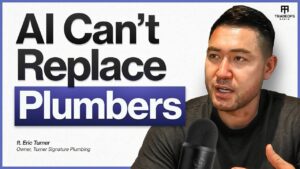
A Master Plumber's Honest Take on AI | The Future of the Trades w/ Eric Turner
Table of Contents
Eric Turner is a licensed master plumber who started in the trades at $10 an hour in 2015 after years as a licensed English teacher and a stint in robotics engineering. He owns Turner Signature Plumbing in Atlanta, Georgia. In this episode of TradeOps Radio, he gives a blunt assessment of where AI genuinely helps small plumbing operations, where it fails completely, and why the same technology terrifying everyone about job security might be the best argument for getting your master’s license right now.
Introduction
Eric Turner was at a Walmart at 10 or 11 PM, picking up medicine for his sick daughter, about two years into a career he was not sure he was going to stick with. He had his radio on. A guest was being interviewed about AI this was 2016 or 2017 and the things the guest was describing sounded like science fiction. “If your job is based on processes and information and integrating information, your job’s gone.”
The interviewer asked whether any jobs would be safe. Without hesitating, the guest said: “Plumbers.” The plumber can walk into a house, put his hand in the wall, feel the pipe, know exactly what kind it is, know exactly what the issue is, know what fittings are needed, and price the whole job without even looking at the problem. “He said that’s a level of complexity that AI would not be able to replicate for like a hundred years.”
Eric went back to work the next day. That interview is a large part of why he stayed.
He is now a licensed master plumber in Atlanta, running Turner Signature Plumbing. His path there was non-traditional: certified teacher (English and special ed), laborer, carpenter, retail, and eventually a two-year detour into robotics engineering. All of that context shapes what he actually says about AI in the trades : more precise and more interesting than most of what you will find on the topic.
Why Plumbing Is the Last Job AI Won't Take
Eric is not making the argument from intuition. He ran a $250 million robot.
During his two-year break from plumbing when COVID wound down, he was pursuing an associate’s in robotics engineering. In that context, he operated an industrial robot whose one job was to pick objects up, move them between five positions, and put them down. “We couldn’t even get that to work right. Seven engineers on site, dudes flying in from across the country to work this thing out, and we still couldn’t get this thing to pick something up and put it down in the exact same space over a hundred iterations.” That is gross movement. Not fine motor skills.
Now apply that to a plumber who needs to be delicate enough to not crack a fitting and strong enough to hulk-out on a corroded nipple. Sometimes in the same hour. “Every single level of strength in between, all of that, every single time.”
The naval armory job illustrates the problem better than any technical argument. Eric went to replace a simple galvanized nipple coming out of a wall. Standard job, done hundreds of times. He cranked it down. The person inside called out: water everywhere. Someone had made an illegal repair behind the wall decades earlier a metal male fitting threaded into a plastic female, which is a code violation. There was no way to see it from the front. When Eric tightened the nipple, the plastic fitting shattered. “Had I known there was plastic, I could have been a little more delicate with it. But I didn’t see it.” He adjusted on the fly, managed the water, learned something for next time.
That improvisation, in real time, based on new and unexpected information, while managing a physical emergency inside someone’s home: that is what every plumber does on a percentage of their jobs. Teaching a robot to do that requires recording every thought process, every physical movement, and every decision of every plumber in existence for years. “Before there’s AI that can even unload your dishwasher by itself, it’s going to be a while.”
His thought on Boston Dynamics posting videos of robots doing backflips on job sites: “A, that’s an OSHA violation. B, I don’t recall the last time I’ve ever needed to do a backflip on a job site.”
The Lindy Effect is the framing Eric uses for the broader argument. If a business category has been around for 50 or more years, it is infinitely more likely to be around for another 50. Plumbing is functionally as old as civilization. “Plumbing and prostitution goes back to the beginning of time.” One of those is not going anywhere.
Where AI Actually Helps (and the Story Where It Failed Completely)
The trade-off between experience and ticket size is one of the most uncomfortable things Eric talks about, and he names it directly.
“The more experienced a plumber is, the less money they make.”
Here is why. When a newer, less experienced plumber encounters a problem they cannot repair, they push for replacement. Replacement is a higher ticket. AI systems at larger companies have identified this pattern and use it to route calls. “Dispatching for dollars” means the algorithm knows which technician returns the highest average ticket on which call type, and routes accordingly. If the licensed guy who is 5 minutes away would come in lower than the unlicensed but high-ticket guy who is 2 hours away, the algorithm waits and sends the second one.
At one company, Eric was pulled aside by his manager and told to “be less detail-oriented and give fewer discounts.” He understood what that meant: charge more, fix less. “You’re telling me not to do the bare minimum. That is problematic. But you’re also saying do shittier work and charge more money.” That was the conversation that pushed him toward running his own business.
Eric’s model is the opposite. When he gets to a house, he offers all the options, including the repair that will actually solve the problem at the lowest cost, even when replacement would generate a higher ticket. “When I give options, I’m like, ‘Hey, we can do a band-aid. We can do an intermediate repair. We can replace the whole thing.’ Whatever is best for that person’s budget when I explains the options they can kind of tell this guy could actually fix it.” His tickets trend lower in some situations because he is genuinely serving the customer.
That is not a business model flaw. It is a trust-building philosophy. The customer he worked with on an expansion tank and a recirculating pump came around to approving both jobs not because Eric pressured him, but because previous work had built enough trust that when Eric pointed out a risk: the old expansion tank could fail while the homeowner was away for two weeks, the customer took it seriously. Trust is what makes that conversation land.
Pricing, the 100% Close Rate Problem, and Why the Middle Kills You
Eric is closing 100% of his calls. That is the first thing to address.
“Closing 100% of your calls? You’re underpriced.” Both Eric and the host reach this conclusion simultaneously. At previous companies with a higher price book, Eric closed at 78 to 85%, with one three-month stretch at 90% and a $1,500 average ticket. He knows what a healthy close rate looks like. One hundred percent is not it.
The mindset barrier Eric describes is common: charging $285 for a toilet repair when other companies are at $525. He is in and out in 15 minutes, which makes it feel like too much money. But “I’m not going to charge less because I’m better at something.” The faster you complete the job, the better you are at it. That should mean higher rates, not lower ones.
The pricing advice from the host is specific and actionable: charge until they gasp. Find a job where a premium price is genuinely justified. Charge a number so uncomfortable you are almost shaking delivering it. If the customer does not visibly react, you are not near the ceiling. If they say yes, you have recalibrated your sense of what people will pay. This is not a recommendation to charge that every time; it is an exercise for breaking the limiting belief. “You might be very surprised about the outcome.”
The other pricing principle: “Don’t be allergic to money.” Money is the oxygen the business needs to survive and grow. Wanting to serve customers well and charging appropriately are not in conflict. A higher price funds better materials, longer warranties, more experienced labor, and a business that is still there when the customer needs someone in five years.
For building recurring revenue through subscription models: Eric believes in the concept and has seen it work but only when an established reputation precedes it. A new plumbing division calling existing HVAC customers to offer a free plumbing inspection generated a 20% close rate and suspicious homeowners. “What that tells me is that they’ve had 20 years to find a plumber. So now we’re just giving them a to-do list.” Subscriptions work when the trust is already there.
The structural framing on pricing: “The middle ground is where businesses go to die.” Be McDonald’s cheap, efficient, high volume, well-oiled machine. Or be Texas Roadhouse premium ingredients, premium experience, charge accordingly. Applebee’s is average food at an average price with an average experience. “It can still work, but you’re stuck in the middle.” The scaling formula that supports either model: cash first, then customers, then manpower, then management. You need the capital before you need the trucks, and the trucks before you need the managers. In that order, every time.
The Incubator Vision and What the Trades Are Actually For
Eric does not want to build a 40-truck fleet. He wants 5 to 6 trucks, all staffed by licensed plumbers who are planning to eventually start their own businesses.
The idea is an incubator. People come in, learn the business from the inside, build relationships with his customers, and when they are ready to go independent, he supports them. If some of his customers want to follow the person they have been working with, that is fine. “While they’re with me, it will cause them to invest themselves into that customer versus I’m just going to get my money and get out of here one day.”
The broader problem Eric sees is an industry that is not cultivating excellent plumbers. Companies putting new guys on trucks after six months. Dispatching for dollars rewarding the less skilled. “I’ve seen it multiple times: the more experienced a plumber is, the less money they make.” He is building something in the other direction.
The trades were stigmatized for decades as a career for people who failed at something else. AI is inverting that narrative. “The most sophisticated technology on the face of this planet cannot do what we do in terms of physical ability, mental ability, problem solving.” People who may have looked down at Eric when he started plumbing a decade ago are now asking how to get their kids into the trades.
His advice to anyone considering the path: sample different trades first, get licensed as early as possible, and think of licensure as the barrier to entry that protects you. “If there’s a trade that’s going to take the biggest hit as far as its efficacy as a business, it’s going to be the ones with the lowest barrier to entry.” Landscaping, pressure washing, lawn care: high competition, easy to enter, hard to differentiate. Master plumbing license: 10 years of experience, state testing, significant skill floor. “You have to earn it.”
And once you are on the other side of that: “I can say what I want and do what I want and fortunately what I want to do is the right thing.”
The Principles That Do Not Change at Any Level
Chris closes with the framing that has stayed consistent across every size of business he has built or coached: know where you are trying to go before you start. “It’s hard to go anywhere when you don’t know where you’re headed. That now determines what kind of actions you need to take in the business.”
The definition of what you are building should come first: what kind of business, what kind of life. That answer is the compass for every hiring decision, pricing decision, and growth decision that follows. Without it, operators drift toward whatever crisis is loudest.
The other constant is the shift from trading time for money to trading experience for money. At a certain point, the business can afford to structure itself so that the owner’s time is spent on the highest-value decisions rather than everything. That point arrives earlier than most operators think if they have done the foundational work.
“How things are and how things start is not how things end. Continue to elevate yourself, gain education, and make decisions. All of that leads to moving you clearer and closer to your goal. Know where you’re trying to go. Otherwise you never arrive.”
FAQ
Every plumbing job is different, which means there is no consistent training data to teach a robot to handle the full range of situations. Diagnosis happens by touch and pattern recognition built over years. Eric worked on a $250 million industrial robot that could not reliably pick an object up and put it down in the same spot after 7 engineers and hundreds of iterations. Plumbing requires far more fine motor control, real-time improvisation, and novel problem-solving than that.
It is a practice where AI-powered dispatch systems route calls to the technician who historically generates the highest ticket on that call type, rather than the nearest or most qualified technician. The unintended result is that less experienced techs who push replacement over repair generate higher tickets, while experienced licensed plumbers who present all options including lower-cost repairs are deprioritized. This builds short-term revenue at the expense of customer trust and long-term retention.
He used AI to fully configure HouseCall Pro in two days, generated a flat-rate price book as a formatted CSV in three minutes, automates receipt uploads to QuickBooks, and uses AI to look up IRC code sections (with personal verification afterward). He is evaluating AI voice assistants for after-hours call intake and scheduling. He does not use AI for plumbing diagnosis, part identification, or anything where hallucination would produce an expensive outcome.
That he is underpriced. At companies with higher price books, his close rate was 78 to 85%, with one three-month stretch at 90% and a $1,500 average ticket. Closing every job means prices are below market, which limits growth and signals to quality-conscious customers that something may be off. The target is a close rate that reflects genuine pricing confidence: 70 to 80% for most home service operators.
The argument is that the middle ground in pricing is the most dangerous place to operate. McDonald's is cheap, efficient, and runs an optimized high-volume system. Texas Roadhouse is premium, experiential, and charges accordingly. Both are profitable within their model and with their target customers. The middle (average quality at average prices with an average experience) is where the most competition lives and where margins are squeezed from both directions. Pick a lane and price into it.

Built For Home Service
We help HVAC and plumbing owners turn their marketing into a system that fills the schedule, month after month.
Explore More