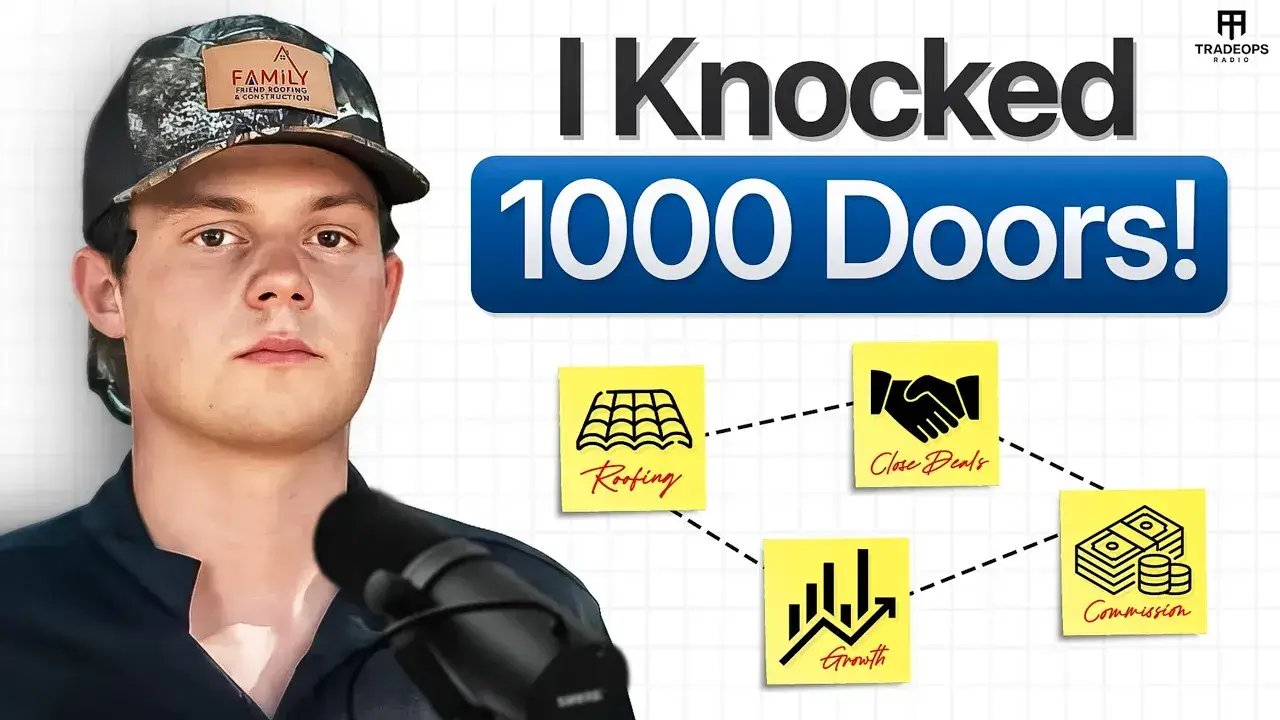
How This 19-Year-Old Sold $2.26M in HVAC (First Year)
· Updated · Yash Singh
Jason Melendez is 19 years old and on track for $2.5 million in HVAC sales in his first full year as a selling technician at his parents’ Dallas company. In this episode of TradeOps Radio, he walks through the full maintenance call process that generates the majority of his revenue, including the group text system that keeps both spouses informed in real time, the silence principle after handing over options, and the porch light close that removes all pressure while keeping the deal alive.
Introduction
Jason Melendez started detailing cars in his neighborhood at 15. He set up a calendar link, built a booking system, ran a marketing campaign in local Facebook groups, and got so busy he had to turn jobs away. He was still in high school. By the time he was working full-time in HVAC, the entrepreneurial instincts were already there. The trade gave them a direction.
He works out of Dallas, Texas, for his parents’ company, where he has been around the business since he was eight years old. His first full year as a selling technician: $2.2 million and climbing toward $2.5 million before the year closes. Every dollar of it is self-generated. He receives no flipped leads. His highest-volume call type is maintenance.
In this episode of TradeOps Radio, Jason walks through the exact process behind those numbers, from the carbon monoxide detector he carries into every gas-system home to the moment he hands the homeowner a notepad and says nothing for as long as it takes.
The Philosophy That Produces the Results
Before any process, there is a belief system. Jason’s is specific: his job is to serve the customer, not to sell them anything.
Serving the customer goes well beyond fixing the system. “Serving the customer could be walking into someone’s house, seeing that their light bulb’s not screwed all the way in, or their door hinge is squeaking, and you put some WD40 on it. Or you change that old lady’s light bulb she can’t reach.” It means asking about allergies, which rooms struggle with temperature, and what the electricity bill looks like. It means treating the visit as a full home assessment, not a single-task call.
The practical consequence of this approach is emotional detachment from the outcome. “If this person buys from me or does not buy from me, I don’t care. My only job is to come in here and serve this person in the best way I can.” The moment Jason steps onto a customer’s property, the mental shift happens: it is about them, not him.
This is not a performance. Customers detect the alternative immediately. “Customers have something called a detector. We all have it. We can sense commission breath from a mile away. If I’m going in there thinking I want to sell you something more than I want to help you, no one’s going to buy from me.” The fastest path to a sale is to stop trying to make one.
Jason credits this entire framework to his mentor, Devin Murphy of Reignite Sales, who has been training him for roughly a year. “Whenever you have that road map, it’s like you can actually drive to your destination. Without it, you’re going to take a very long time to get there.” When Murphy came to the company to train the technicians, Jason was the one who absorbed everything and asked for more. He was coachable. That coachability is how he describes most of the speed behind his growth.
The Maintenance Call from Start to Finish
Most companies consider maintenance calls the lowest-value call type. Jason’s highest-revenue months are maintenance-heavy months. He builds his own opportunity on every one.
Five steps. Every sales process follows the same sequence: identify the problem, make the customer aware, stimulate the pain, present the options, ask for the sale.
The arrival. Shoe covers are on before the door opens. He carries a carbon monoxide detector for gas systems and a thermal gun for temperature readings. He knocks, introduces himself, shakes hands, and immediately asks whether where he parked is okay. That small question signals consideration and starts the interaction on the right footing.
Setting expectations. Before touching anything, Jason tells the customer what the visit actually is: a professional inspection to check safety, efficiency, comfort, and correct operation. Many homeowners assume a maintenance call means someone pokes around for 30 minutes and leaves. Setting this expectation upfront is what earns the time commitment: “I’ll be here for about X amount of time. Do you have that time for me today?”
Discovery. The questions that come next are about the homeowner’s life in the house: allergies, rooms that are hard to keep comfortable, electricity bills, any imbalances they have noticed. This is not small talk. The answers map where to focus and what to surface later. “I want to make sure I can identify everything and give them the option to take care of it.”
He also tells them directly: “I’m here to provide five-star service. If at any point in this call I don’t, will you let me know?” That setup serves two purposes: it signals professional standards, and it creates an honest opening to ask for a Google review at the end of the call.
Walking them through the home. Jason asks the customer to show him four things: the thermostat, the indoor system, the outdoor system, and the breaker panel. The customer physically walks him to each location. “That’s an excuse for me to build rapport and discovery. When they walk me to their attic, walk me outside to show me where their condensing unit is, that gives me time to break the ice. Now they can understand that I’m a human as well.”
The real-time text system. This is the tactic Jason describes as the biggest conversion driver he has added. He pulls both the homeowner’s and their spouse’s numbers from Service Titan and creates a group text thread. As he goes through the inspection, he photographs or records every issue he finds, pastes his pre-written description from a notes app list of every common HVAC problem, and sends it to the thread in real time.
Two outcomes: both decision-makers are always equally informed, which eliminates the one-leg problem (only one spouse is home), and the homeowner is tracking along with the inspection from wherever they are sitting. By the time Jason comes back inside, the customer has already been processing the findings.
Every issue gets communicated three times before options are presented: once by text, once in person when Jason brings the customer to see it firsthand, and once again in writing when he goes over the full system evaluation. “Now the customer cannot not understand what’s going on in their system.”
Bringing the customer to the problem. “You have to make problems real. They have to see it, touch it, be around it. If I tell you that’s failing and you see a picture, it doesn’t hold weight because you can’t really attach it to anything. But if I bring you to your HVAC system and show you, have you touch it, feel it, maybe hand you my meter and have you test it yourself, now the problem is real.”
Dumbing it down. “An HVAC system is very complicated. If you explain something to a customer like you’re talking to another technician, they’re not going to understand you. It’s your job as a professional to figure out how to make it simpler.” Technicians who speak in system specs and part numbers lose the customer’s comprehension and trust at the same moment.
The Options Presentation and the Silence Principle
After going through everything, Jason does not build the options and present them. He asks the homeowner a question: “That’s the end of my process. What do you want me to do from here?”
The majority of homeowners respond by asking for repair quotes. In cases where the answer is uncertain, he uses social proof to bridge it: “What most of my other customers have me do is write out a full system evaluation so they completely understand everything going on with their unit. Would you like me to do that for you?” The customer opts in. Jason did not push them.
He pulls out a small white legal notepad and writes down every issue noted during the inspection. Options are built from the top down: the highest option covers everything on the list, each step below covers progressively less. He typically stays between three and six options. He always leads with financing. “Especially with the economy like today.”
Then he hands them the notepad and stops talking.
“Jordan Belfort, the Wolf of Wall Street. Whoever speaks first loses.” Once the paper is in the customer’s hands, Jason does not add product information, mention discounts, or try to manufacture urgency. He waits. He once sat in silence for over an hour while a customer studied the options. He did not break. “Silence isn’t a sign of confusion. Silence is a sign of engagement in that specific scenario. They’re calculating. They need that time to think.”
Most technicians panic in that silence and start talking. When they do, they undermine the trust they just spent the whole visit building.
The Porch Light Close and the LYRIC Objection Framework
When the customer comes back with hesitation, “we didn’t expect to spend this much today” or “we need more time,” Jason does not try to overcome the objection in the room. He does the opposite.
“The last thing I’d ever want to do is discuss your finances in front of me. I’ve got about 20 to 30 minutes of notes I have to fill out just for your specific call. I’m going to go to my truck and fill those out. You guys talk about it as much as you want. Any questions or concerns, just come give me a wave when you’re done.”
He goes to his truck. All pressure leaves the room. “Most customers don’t need weeks, two weeks, months, days. They just need some focus time.” When they wave him back in, they either commit to an option or give him their real objection.
For objections, Jason uses LYRIC: Listen, Acknowledge, Repeat, Isolate, Close.
The sequence: listen fully to the objection, acknowledge it genuinely, repeat it back to confirm understanding, then isolate the actual root. “Is there anything else besides the cost that’s keeping you from getting this taken care of?” If the answer is no, the objection is cost. Now he knows exactly what he is dealing with.
Then he isolates further: “Is this something you don’t feel is worth spending X dollars on, or do you think you just can’t afford it?” The two possibilities require completely different responses. If they cannot afford it, financing is available. If they do not see the value, something was missed in the explanation and he goes back to re-examine that piece.
“When people give you objections, it’s usually only because they don’t have enough information or they don’t like you. People do business from people they like. People do business with people they respect.”
The Mindset Behind the Numbers
Handling age bias. Jason has only had one customer ask for a more experienced technician. His strategy is preemptive: he walks in like a professional, looks them in the eye, shakes their hand firmly, and speaks like the expert he is. “If I don’t treat myself like a young kid, they will not treat me like a young kid. People treat you how you teach them to treat you.”
Hate comments. His social media posts draw negative reactions from people who call HVAC sales predatory. “First thing I do is laugh.” His point: what he does is identify a problem, make the homeowner aware of it, show what happens if it is left unaddressed, give them the option to fix it, and ask if they want to. That is communication, not manipulation. The engagement from negative comments feeds the algorithm and expands his reach. He has first-hand video reviews and written testimonials from real customers whose lives he improved. Those carry more weight than anonymous comments.
If he could go back. Two things: manage money better from the start (income was flowing out as fast as it came in) and be more coachable earlier. “When I didn’t follow my mentor’s advice, that held me back. If I had started more humbly, I would be at 3 to 3.5 million, maybe even 4 million right now.”
For young technicians entering the trades. “There is seniority in this industry. People will try to tear you down because of your age and your experience. But the only person who controls whether that actually happens is you. Be delusional about your goals. Be delusional about the things you’re going to achieve and the speed at which you’re going to do it. It will happen.”
FAQ
How did Jason Melendez reach $2.2 million in HVAC sales at 19 years old?
Through a mentor-trained process built on emotional detachment from the sale, a thorough maintenance inspection that surfaces and communicates problems three separate times before options are presented, and consistent self-generated leads. He receives no flipped appointments. All revenue comes from maintenance calls, service calls, and marketed leads he handles independently.
What is the porch light close in HVAC sales?
After presenting options and receiving initial hesitation, the technician tells the customer they need to fill out notes in the truck and invites the customer to come give them a wave when they are ready. This removes all sales pressure from the room and gives the homeowner uninterrupted time to think. Most customers simply need focused time, not more days, to make a decision.
What is the LYRIC objection framework?
Listen, Acknowledge, Repeat, Isolate, Close. After hearing an objection, the technician listens fully, acknowledges it genuinely, repeats it back to confirm, then isolates the real cause. The key isolation question: is this a value problem (they do not believe the fix is worth the cost) or a financial problem (they cannot afford it)? Each requires a different response, and knowing which one you are dealing with determines the next move.
Why do Jason's maintenance calls produce more revenue than marketed leads?
On marketed leads, the problem and urgency already exist, and multiple companies are often competing. On maintenance calls, there is no pre-existing urgency, which means Jason can control the narrative by discovering issues the customer did not know about, making those issues real through physical demonstration, and creating the urgency organically through a thorough inspection. He can guide the entire conversation rather than responding to one the customer has already framed.
How does Jason handle customers who question his age or experience?
He rarely encounters it because his posture preempts it. He walks in with direct eye contact, a firm handshake, and speaks with authority from the first sentence. He does not apologize for his age or mention it. "If I don't treat myself like a young kid, they will not treat me like a young kid. People treat you how you teach them to treat you."
More leads for your sales team to close: Lead generation for HVAC companies.