The Secret to Closing More HVAC Deals: Emotional Selling & Rapport Building w/ Sam Wakefield
· Updated · Yash Singh
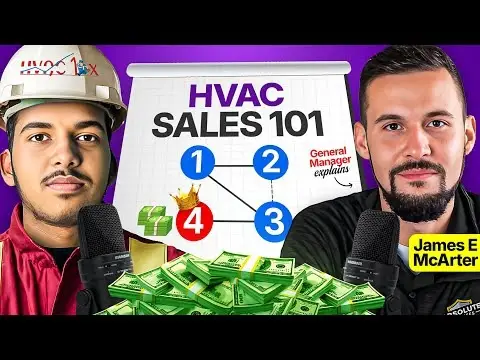
Sam Wakefield has 19 years in HVAC and runs Close It Now, a sales coaching company for the trades. In this episode of HVAC Hotshots, he covers why post-COVID buying patterns demand emotional selling, how storytelling from the discovery phase eliminates buyer’s remorse, the four sales every house requires, and the Average Dollar Per Lead KPI that simplifies every revenue goal.
Introduction
Sam Wakefield was on an install crew in a 140-degree attic when he grabbed a live 220-volt wire. It held on. The person next to him had to kick him free. He quit the next day.
The owner called him back weeks later and offered him sales. Sam ran his first appointment and sold it. He had no idea what he was doing, and the homeowners bought the excitement. A light went on. He spent the next 19 years going deeper into that craft, exiting two companies along the way, and eventually building Close It Now, a sales training and coaching system for HVAC and the trades. His podcast on the same topic is recording its 200th episode this week.
In this episode of HVAC Hotshots, Sam covers the most significant shift in how homeowners buy since before the pandemic, how to build a sales conversation that prevents objections instead of reacting to them, and the single KPI that the majority of HVAC companies are not tracking but should be. Keep reading.
Why Logic-Only Selling Is Losing Deals Right Now
The buying patterns that existed before 2020 no longer exist. The pandemic and everything that followed created the largest Home Improvement boom the industry had ever seen from 2020 to mid-2023, and then the market returned to normal. Most of the people who entered the industry during the boom thought the contraction was a crash. The people who have been around for a while recognized it as baseline.
What changed permanently is how people make decisions. “People buy on emotion, they justify with that logic, and then they justify the logic with another emotion.” For decades, HVAC sales ran almost entirely on logic: here is what’s broken, here is why you should fix it, here is the price. That approach is losing buyers that a more emotionally intelligent conversation would keep.
The proof is visible in the culture. Before 2020, the phrase “I was emotionally triggered” did not appear in mainstream conversation. Now it does constantly. Society has given people permission to acknowledge and express their feelings. Like it or not, that is the buyer sitting across from your technician, and if the conversation stays in the logic lane, it is going to miss them.
The language shift is not complicated. “How does that make you feel?” and “if we could improve that, would that help?” are the core questions. When a homeowner connects emotionally to a problem and can see emotionally what life looks like after it is resolved, urgency happens without being manufactured. Sam frames it this way: if you tell someone that tomorrow their life is going to change because this project is done and they will not have to experience this problem any longer, they do not care what season it is. That is urgency. The industry has been trying to manufacture seasonal urgency instead of creating the real thing through emotional connection.
Two reasons people take action, and both have to be present: they are moving away from pain, or they are moving toward pleasure. Most HVAC sales conversations address the first one reasonably well. Almost none address the second one. That gap is why buyer’s remorse happens.
The Sales Process That Prevents Objections Instead of Reacting to Them
Before objections come up, sales puts them there.
“Anyone who gets the same objection consistently, it’s not the market, it’s not the company. It’s something you’re saying along the way in your process that’s causing them to think about it.” Recurring objections are planted by the salesperson. The fix is not a better objection script. It is a better process.
Sam’s first issue with how most HVAC companies are built: sales is the last system they implement, when it should be the first. Operations, fleet, installation, service divisions all get documented before anyone builds a consistent sales framework. By the time they get to sales, overhead has grown and there is no margin to absorb the gap. If a company starts selling at the margin they need to sustain the company they want to build, every growth wall they hit is easier to cross. “Nothing happens until something gets sold.”
The process starts with permission. Before a technician begins any inspection, the question is: “Is it okay if I ask you a few questions about what you’re experiencing and what your concerns are living in your home? Because you’re the one living here, not me.” This framing immediately repositions the technician from someone who came to look at equipment to someone who came to understand the homeowner.
“The house doesn’t write the check. People write the check. People will pay more for what they want than what they need.” Spending the first portion of the visit asking deep questions and listening is not a detour from the sales process. It is the foundation of it. “Listen to understand, don’t listen to respond.” When you listen to understand, you pause, ask better follow-up questions, and build a picture of what the homeowner is actually experiencing.
The most common disconnect: technicians identify the cause of the problem and talk about it as if it is the problem. The disconnected ductwork is not the problem. The room that is too hot in summer and too cold in winter is the problem. The broken capacitor is not the problem. The feeling of paying for a system that seems like it should be working and is not working is the problem. The language has to match what the homeowner is perceiving, not what the technician diagnosed.
“Can you see how, by this happening, it’s causing the problem you’re having?” That bridge sentence connects the technical finding to the lived experience. Without it, mechanically-minded homeowners can bridge the gap themselves. A large portion of the population cannot. Fixing that bridge is the job of the process.
The Daughter Story and Why You Must Paint the Future
Even a well-executed discovery and a correct diagnosis will produce buyer’s remorse without the future component.
Here is how it breaks down. The technician uncovers the problem clearly. The homeowner understands it. The solution is presented. The price is agreed on. The appointment ends on a high. Then two hours later the homeowner calls back and says they are going to get other bids. Or the next day: a different company told them they do not need all that. The sale is in jeopardy.
Why? Because the conversation ended on the problem. The homeowner is now crystal clear on what is wrong, which makes it easy to shop for whoever will fix it cheapest. There is nothing pulling them forward.
The future component the “moving toward pleasure” piece is what keeps the sale alive after the technician leaves. Sam walks through a specific example he teaches. A daughter’s bedroom is too hot in summer and too cold in winter. Two fans running. She is sweating at night, grumpy in the morning, struggling at school. The ductwork is disconnected.
The conversation does not end with “here’s how we fix the ductwork.” It ends with: “Won’t it feel great to know that she’s not going to have to have those fans running, she’s going to sleep better, she’s going to wake up less groggy? Watch her school work. Watch her extracurriculars. All these things are going to turn around because now she’s sleeping properly.”
When the homeowner leaves the conversation in that place, the discussion they have with their spouse that evening is: “This is going to be great. We’re getting her room fixed.” If they do get buyer’s remorse and call another company, the conversation when they come back is entirely different: “I hear you. Would you like to know why homeowners choose us even though other companies are cheaper? How much certainty do you have that the lower-priced option is going to solve this to the same degree? We’ve done hundreds of these projects in this area. Are you willing to roll the dice?” The future vision is what makes that conversation easy.
The storytelling does not start at the presentation. It starts in discovery. Everything collected during the questions phase becomes the language of the solution. “Remember earlier you mentioned…” is one of the most powerful phrases in the process.
Handling Objections: Think About It and the Price Is Too High
“I want to think about it.”
This is almost never a real objection. It is a stall feature that covers the actual concern. Sam’s approach: verify the four sales that have to be made in every house before the real issue becomes clear.
There are four things a homeowner is evaluating: the company, the person (the technician or project manager), whether the project makes sense and will solve the problem, and the price. Sam works through the first three as a sequence of quick confirmation questions. You were comfortable with the company? Good with me overseeing the project? The project makes sense and you can see how it solves the problems we talked about?
Then: “So why don’t we get on the calendar?”
That sentence cuts through to whatever the real objection is. If the first three are confirmed and they still hesitate, the hesitation is almost always price. Now the conversation can be about what it actually is.
The Google reviews framing was introduced earlier in the visit deliberately. When the price objection surfaces: “Do you think we’d have 1,082 Google reviews at a 4.9 star rating from people in your area, in your own neighborhood, if we were out here taking advantage of people with price or price gouging?” Most homeowners will say no. That is the acknowledgment, not the objection. “Treat it once as never, twice as always.” If it comes up once, brush past it and assume the sale. If it comes up a second time, that is when you address it directly.
The question that opens the real conversation: “Compared to what?” Do they have other quotes? Did they Google a number? The frame of reference determines the entire response.
Handling a real price comparison.
Sam teaches a best price guarantee, not a price match guarantee. A price match invites them to shop around and then race you to the bottom. A best price guarantee says: we are already giving you our best, now let me show you why the projects are different.
The mechanic analogy: take the same alternator for the same car to three different mechanics. The dealership uses factory parts, highest warranty, most expensive. The local shop does good work at a middle price with a shorter warranty. The shade tree mechanic under the tree warranty lasts until you pull out of the driveway. “With us, we’re the factory specification design company. No one is taking the steps we are.”
The F-150 analogy: it is the same equipment being delivered in 300 boxes. You are choosing who assembles it and to what standard. If another company is $3,000 cheaper, what else are they skipping to get there?
Price broken down over time: if the difference is $1,000 over 10 years, that is a couple of dollars a week. “Is it worth it to you for a couple of dollars a week to know it was done right the first time?”
The ethics statement: at the start of the appointment, Sam teaches opening with a written ethics statement “Is it okay if I read you our commitment to you?” When price comes up later, the response is: I made these commitments to you at the start. What importance does it have to you to work with a company that stands behind their word? That single shift puts the entire conversation on different ground.
Average Dollar Per Lead, Follow-Up, and Becoming Someone Worth Buying From
The KPI nobody is tracking.
Average ticket and close rate are common. The metric that does the most work with the least complexity is Average Dollar Per Lead: total revenue divided by total number of appointments, including every appointment regardless of outcome. Sold or not, that is the value of every door knock.
This number equalizes what ticket and close rate cannot. A technician with a high close rate who discounts everything may produce less revenue per lead than a technician with a lower close rate who sells at full margin. The Average Dollar Per Lead reveals who the more valuable player actually is.
From a planning standpoint: if every door knock is worth $850 to the company, the path to any revenue goal is a simple division problem. How many appointments are needed? That is the lead generation target. From there, working backwards, everything else follows. “Losers look at winners. Winners look at the finish line.” Build KPIs from your own P&L and overhead, not from what competitors are posting.
Follow-up.
The average buyer makes a purchase after seven to eight follow-ups. The average HVAC salesperson follows up once. The gap between those two numbers is the money being left behind.
BAMFAM: Book a Meeting from a Meeting. Never leave an interaction without a scheduled next contact. Before wrapping up any appointment that did not close: “I want to make sure I’m available for you. Go ahead and grab your calendar right now, I’ll grab mine, and let’s lock in when we’re going to talk next.” The sale is not over. It is part two.
Sam shares an eight-month follow-up story. A client said not yet, month after month. Sam kept the next meeting scheduled. After eight months: a $52,000 project. What the client said: “We liked the other company and the other person better. But you were the only one who kept reaching out. It was clear you wanted to earn our business.”
The January challenge: call every appointment from the previous year that did not close. A salesperson in the Northeast did this in the first week of January and closed over $200,000 without leaving his house. The business is already sitting in your CRM.
Becoming someone worth buying from.
Sam teaches what he calls the Wheel of Success: six elements that a top performer has to keep in balance. Sales skills are one of the six. The other five are personal growth (daily podcasts, books, content), nutrition and fitness (“you don’t put cheap fuel in a race car”), relationships (have you read a parenting book?), calendar management, and spiritual practice aligned with your own belief system.
“Sales is not the performance of an hour. It is the Overflow of a life.” When someone from one industry drops into another they know nothing about and still becomes a top performer quickly, it is because they have developed the person, not just the skill. “Your beliefs create your identity. Your identity creates your outcomes. You don’t get what you want. You get who you become.”
The community play for competing against private equity-backed companies: if the internet did not exist, how would you promote your business? Visit property managers and HOA offices in person. Sponsor local sports teams. Run an ice cream social in a neighborhood. Join networking groups and show up. Door knock “nobody in this industry knocks doors and it’s to their detriment.” Become so present in the community that when someone needs HVAC, they are not Googling. They are calling the person they already know.
FAQ
How has buying behavior in HVAC changed since 2020?
Homeowners now make decisions far more through emotion than logic. They buy on emotion, justify with logic, and then validate that logic with another emotion. A sales conversation that stays in pure logic mode here is what is broken, here is how we fix it misses the buyer. Effective HVAC sales now requires asking how the problem makes the homeowner feel and showing them how their life will change once it is resolved.
What is the most important KPI for an HVAC sales team?
Average Dollar Per Lead: divide total revenue by total number of appointments, including all calls regardless of outcome. It equalizes what average ticket and close rate cannot, because it accounts for discounting behavior. It also allows backward planning if you know each appointment generates $850, the path to any revenue goal becomes a simple math problem.
How do you handle the "I want to think about it" objection?
Verify the four sales that need to happen in every house: company, person/project manager, project makes sense, and price. Confirm the first three, then ask "why don't we get on the calendar?" This cuts through to the real objection, which is almost always price. Treat the first mention of price as a comment, not an objection, and assume the sale. If it comes up a second time, address it directly.
Why do homeowners experience buyer's remorse and how do you prevent it?
Buyer's remorse happens when the sale ends on the problem without painting the future. The homeowner leaves clear on what is wrong, which makes it easy to shop for the cheapest fix. Adding the "moving toward pleasure" element showing them specifically how life will be better once the work is done gives them something to be excited about. When they talk to their spouse that evening, the conversation is about the positive outcome, not about whether to get more quotes.
How important is follow-up in HVAC sales?
Critical. The average buyer makes a purchase after seven to eight follow-ups. The average salesperson follows up once. The fix is BAMFAM (Book a Meeting from a Meeting): never leave an appointment without scheduling the next contact. For slow periods, calling every unsold appointment from the prior year is one of the highest-ROI activities a salesperson can do.
Related: TradeOps plans and pricing.