The HVAC Playbook No One Teaches You: Anna Rickett Smith on Culture, Pricing & Community
· Updated · Yash Singh
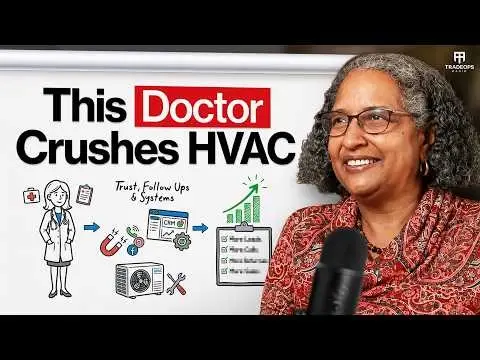
Anna Rickett Smith is a former USDA economist who opened a gym, led sales for a $124M company, and bought an HVAC company in Duluth, Georgia in 2024. In this episode of TradeOps Radio, she covers the culture rebuild that replaced her entire original team, the membership structure bringing in nearly 20% of revenue, community marketing tactics including a Plinko board that builds an email list, and how she structured her owner-financed acquisition without prior dealmaking experience.
Introduction
Anna Rickett Smith’s path to owning an HVAC company in Duluth, Georgia, started with an antitrust expert witness job at the USDA and ran through a failed gym, a layoff from a national sales company, and four years helping a technician-friend build his business through COVID. This is her third company. The first one she has ever bought.
Hero AC has been in operation since 2006. Anna bought it in April 2024. She is in the largest county in Georgia, northeast of Atlanta, with a company she calls ripe for leadership at every level: culture, compensation, marketing, and systems. In this episode of TradeOps Radio, she works through all of it.
Three Companies, Three Lessons That Led Here
The gym. Anna opened a fitness business and by every visible measure it looked like a hit. The facility was packed. Members loved the experience. She was excellent at the thing she was selling.
She was also ignoring the entire cost side of the equation. The 4,000 square foot facility she ran out of carried overhead that a 400 square foot space could not justify. “I really needed to acknowledge that my passion of loving on people, if I was working out of a 400-foot facility, was just as good. I had a real estate problem. It was very expensive.” She sold the business at a net loss. The lesson was expensive: great service and great financials are not the same thing. “Know your numbers. Be married to your spreadsheets. Look at your P&L and your bank account every day.”
The corporate job. She was recruited to lead sales teams in the southeast for a nationwide company doing $124 million in annual revenue. Her team grew from scratch to the top half percent of the entire company. Then they laid everybody off.
What she took from that job was not the revenue number. It was the leadership philosophy. “It is not about you. It is about your team.” Her current operating model is built entirely around fading into the background. Customers should not know she exists. The team should not need her. “My number one goal is for everybody to be developed in their role such that they don’t need me.” Simon Sinek’s Leaders Eat Last is the framework. Servant leadership is the operating mode.
The HVAC company. A technician friend asked her to come help during COVID. There were no systems in sight. Anna built them. They grew the business significantly through the boom years. Eventually the technical demands of running the operation started wearing on him and the business model did not support both of their income expectations. “One of the places we diverged was I said we have to take our paychecks and reinvest them in marketing. And he was like, ‘I’m not taking a pay cut.'” Anna bought the whole thing.
She also invested $10,000 in a high-dollar coach for three months after the acquisition. The old team had no culture of accountability and she needed help keeping her head on straight while building a new one. “I credit him with keeping my head on pretty much straight through the whole thing.” The return on that coaching spend: roughly 200% growth. Every goal the company set for the year was either hit or came within a percent. Her framing on coaching in general: “It’s paying down your ignorance debt. There are things people know that you don’t and paying for the information is the cheapest way to go about it.”
Her advice to aspiring owners: find people who have exactly the freedom and financial picture you want, and listen to them like it is the gospel. Do not listen to people who try to talk you out of it, even well-intentioned ones with integrity. “They will tell you what if you work really hard and it doesn’t happen. You only want to listen to the people who have the freedom and the financial picture that you want.”
Rebuilding the Culture From Scratch
Zero original employees survived the transition.
The team Anna inherited had been hired to be yes-men. No accountability. Zero expectation. Brothers with the owner who wanted to get off at 3:00 and never hear about growth again. “They loved it that way. They wanted no accountability and to smoke and joke and make the same money forever.” Anna built programs, offered opportunity, tried every angle. They did not want that. They wanted things as they were.
When she hired the new team, the process had four stages. Reference checks, background check, MVR (motor vehicle record, commercial auto insurance rates spike significantly with driving violations), and a vibe check were all completed before the final interview. Candidates also completed a paid ride-along before Anna ever met them. “By the time they get to me, we know they’re qualified. What I find out in my interview is: will you follow me?”
The final interview has two core exercises. First: “Write down 10 things you want to accomplish in the next year.” The question completely catches technicians off guard. Anna hired the ones who looked at her like she had four heads for a moment and then immediately leaned in with “yes ma’am.” She passed on anyone who hesitated, giggled nervously, or drew a blank.
Second question: “What is your number one motivation? What are you trying to achieve by having a job here?” If the answer is not money motivation, the conversation ends. She had one candidate say he wanted something “secure and stable” and that he did not “have to make a lot.” “Nothing wrong with him. But that’s not who needs to work here. I need somebody who is like, I want to go on vacation. I want to make big money. We can work together with that.”
The goals from that exercise go into the employee’s file. They are returned to at every one-on-one. “This is going in your file and we’re going to make this happen together.” Professional goals align with the company mission, which Anna repeats at every meeting and there are three meetings per week: “Return life and value back to the employees that help this company grow. Life and value is code for money and freedom.”
She prefers to hire fresh from trade schools and train them fully rather than recruit experienced technicians who carry opinions from other companies. Remote techs who are in customers’ homes independently and who have experience elsewhere can feel like they have leverage. “I cannot go in those homes. I cannot make them. They can check those checklists. So when those guys have a little swagger, what are you going to do? You can’t come fix this, they’re right.” Starting fresh and training your way eliminates that dynamic. She sits on the board of local trade schools and visits their classes to find the right people early.
The Membership Structure and What Maintenance Calls Are Actually For
The membership was not selling before Anna took over. The previous team treated maintenance visits as filter changes and nothing more.
The current structure: $210 per year for one system, billed monthly. Anna prices it just at or slightly below cost. It is a loss leader that gets the company in the door twice a year. Multi-system pricing adds each additional system at a progressively lower rate. The two-for-one framing does the selling: “For what it costs to come out today, we can come twice.” Members also receive 15% off service tickets.
The process: as soon as a customer calls, the CSR introduces the membership before anything else. At the visit, the technician walks in with a color-changing cup, a koozie, and the Comfort Club flyer. At the end of the appointment, the tech mentions the 15% discount and asks. Close rate on eligible new customers: over 50%. Customers who said no in the past get a different angle: “You keep coming back. Why don’t you just let us maintain your system and you would have saved this much on these last two repairs?”
Anna strongly prefers monthly billing over annual. She comes from a gym membership background. Monthly recurring draws are gold in slow season. Memberships are close to 20% of Hero AC’s total revenue. “It’s invaluable. We wouldn’t be here.” That says enough.
In-home sales work the same way. When the technician is on a maintenance call, the mindset is that the company is getting paid to market to this customer. The philosophy: solve more problems while you are in the home and save that customer money. Look for allergies, pets, register buildup, room imbalances, electricity bills. “Can you match any of their needs with anything we can do? And everybody wins.”
Anna does not use the word “upselling” with her technicians. Most techs went into HVAC specifically to avoid sales. Using that language adds pressure that works against you. “I’m trying to educate technicians how to maximize what we can do for the customer, and oh by the way, you’ll make this much for everything.” The right pay plan aligned with the right people does the rest. Her current team started educating themselves on product options and coming to her with recommendations. “They’re coming to me going, ‘I really think we should look at this air cleaner. It works better.’ I’m like, if you say so, you’re the technician. Here’s the price. Go for it.”
The five-star review holds as much weight as the revenue number. “You should never hear from somebody that this person pushed us.”
Marketing on a Budget: Community, Events, and the Plinko Board
When Anna bought the company, there was no marketing budget. The previous owner’s reputation was strong enough that 40 to 50% of the business was pure word of mouth from people who called him directly. He was excellent at the work. The business was capped at what one man in a van could service.
Now Anna’s marketing stack has several layers. SEO and the company website were already in place. Facebook provided some social proof. In year two, she added five paid networking groups per week, a county chamber of commerce golf tournament sponsorship, a booth at a local beer festival, and an expert article column in a glossy magazine targeting upscale neighborhoods.
Marketing budget target: 10 to 12% of revenue, following what she learned from industry reading and podcasts. That percentage goes into overhead, which then gets built into the price book as a per-hour-per-tech calculation. She also loans money to her own business to fund marketing experiments without touching the net profit numbers that drive team bonuses. “That’s my risk to bear. I decided to pay them on that margin. I wanted to make sure they got paid for what they sold, not because of what I spent.”
The Plinko board at the beer festival is the tactic worth stealing. She put up a Plinko board and gave away a bottle of bourbon every hour to anyone who entered to play. People were obsessed. She collected name, email, and phone numbers at every entry. Five emails and two texts over eight weeks produced one response: a customer who wanted both systems looked at. Potentially a $3,000 ticket from a $3,000 event spend.
The broader principle: events and community sponsorships build brand equity before the need exists. When someone thinks HVAC in Grapevine or in Duluth or in your market, you want to own that space in their head. The in-person events do that work in a way that digital advertising cannot replicate. But they can also produce measurable outcomes if structured correctly.
Her suggestion from the conversation: use events to build the customer database first and sell the membership second. Give out raffle tickets for contact information. Offer more entries for signing up for the monthly membership. Someone will spend $30 on a membership at an outdoor event if the exchange feels fun and low-pressure. “Lead generation at an event is not about the HVAC system. It’s about getting on the membership.” That email list goes into remarketing campaigns, SMS, Facebook retargeting. The cost-per-lead from events becomes trackable over time.
The distributors are another underused resource. When Anna had a subcontractor install a system with two mismatched line sizes and a very particular engineering homeowner, she had no idea what to do. Her distributor rep pulled up the install manual, called the homeowner directly, and walked him through why the line set was compatible and what the efficiency difference actually was. He was essentially functioning as a service manager for Hero AC. “He did not have to do that.” Not every rep will, but the relationship is worth investing in specifically because of moments like that one.
Buying the Business and the License Problem
Anna structured the purchase through owner financing: a HELOC on her personal home plus a 10-year note with the previous owner. The business was independently valued for $2,000, with both parties splitting the cost so neither had an argument about who picked the valuer. They used the owner’s attorney, who walked them through an operating agreement. The interest rate was the minimum allowed by law, somewhere around 5%, because they were friends.
The psychological benefit of owner financing she did not expect: the seller genuinely wants the business to succeed because they have a monthly check tied to it. “He psychologically and financially wants you to pay that bill.” The caution: once someone has one foot out the door, they are mentally 85% gone. She benefited from having been inside the business for four years before the purchase, so her due diligence was built-in. “I knew the P&L and the asset sheet. I knew we had 3,000 people in the customer base. I knew we had no marketing. I just knew.”
The license problem was the one that kept her up at night. She paid the previous owner for use of his license through the end of the year she bought the company. That gave her roughly seven months to find a qualified license holder who would take a monthly payment. The legal requirements: they must be on the W2, have access to all company books and CRM, and be reachable at all times. They do not have to live in your state, but they must hold a valid license for it.
How she found hers: through a distributor referral. Her warehouse manager knew someone who had retired and held a Georgia conditioned air license and was looking for an arrangement like this. They met at a McDonald’s, signed a contract, and she pays him monthly. “I was in a panic. I had a 10-year note, money on the line, a new business, and seven months to find a license holder.” The lesson: networking and distributor relationships solved it faster than anything else she tried, including texting through the public list of Georgia license holders one by one.
Her long-term goal is to obtain her own license, eliminating that ongoing expense and dependency entirely.
For anyone thinking about acquisition, she recommends Nathan Linley of Linley Home Services on LinkedIn as someone who speaks the language of rolling up home service businesses at a level she is still learning from. “I read him and I’m thinking, I don’t have a clue how to do this. Not really.”
FAQ
How did Anna structure the purchase of Hero AC with no prior dealmaking experience?
Through owner financing. She used a HELOC on her personal home plus a 10-year promissory note with the previous owner. The business was valued independently for $2,000, split between both parties. They used the seller's attorney to write an operating agreement with minimum legal interest. Her due diligence came from four years of working inside the business as a partner before buying it.
What does Hero AC's membership structure look like?
$210 per year for one system, billed monthly, priced at or slightly below cost as a loss leader. The CSR introduces it on every incoming call. At the visit, the technician brings branded merchandise and the membership flyer. The two-for-one framing closes over 50% of eligible new customers. Memberships are billed monthly rather than annually to produce a recurring float. They represent nearly 20% of total company revenue.
How does Anna screen for the right technician in her hiring process?
Four stages: reference checks, background check, MVR check, and a paid ride-along are all completed before Anna meets the candidate. Her final interview includes two components: a goal-setting exercise where the candidate writes 10 things they want to accomplish in the next year, and a direct question about their number one work motivation. If the motivation is not financial, the conversation ends. She strongly prefers hiring fresh from trade school and training from scratch over recruiting experienced technicians.
How did she solve the HVAC contractor license problem after buying the business?
Through a distributor referral. Her warehouse contact knew a retired technician holding a valid Georgia conditioned air license who was willing to work on a monthly arrangement. The arrangement requires the license holder to be on W2, have access to all books and CRM, and be reachable at all times. They do not need to live in the same state, only hold a valid license for it. She pays him a monthly fee and is working toward obtaining her own license.
What is the Hero AC company mission and how does it drive hiring and culture?
"Return life and value back to the employees that help this company grow." Life and value is code for money and freedom. This mission is stated at every team meeting, which happens three times per week. Every hiring decision, pay plan, and operational choice is mapped back to whether it genuinely serves that outcome for the team. The mission is also used as a filter in interviews: Anna asks candidates which of their 10 professional goals they could realistically accomplish at Hero, then holds them to it.
Related: Facebook ads for HVAC companies.