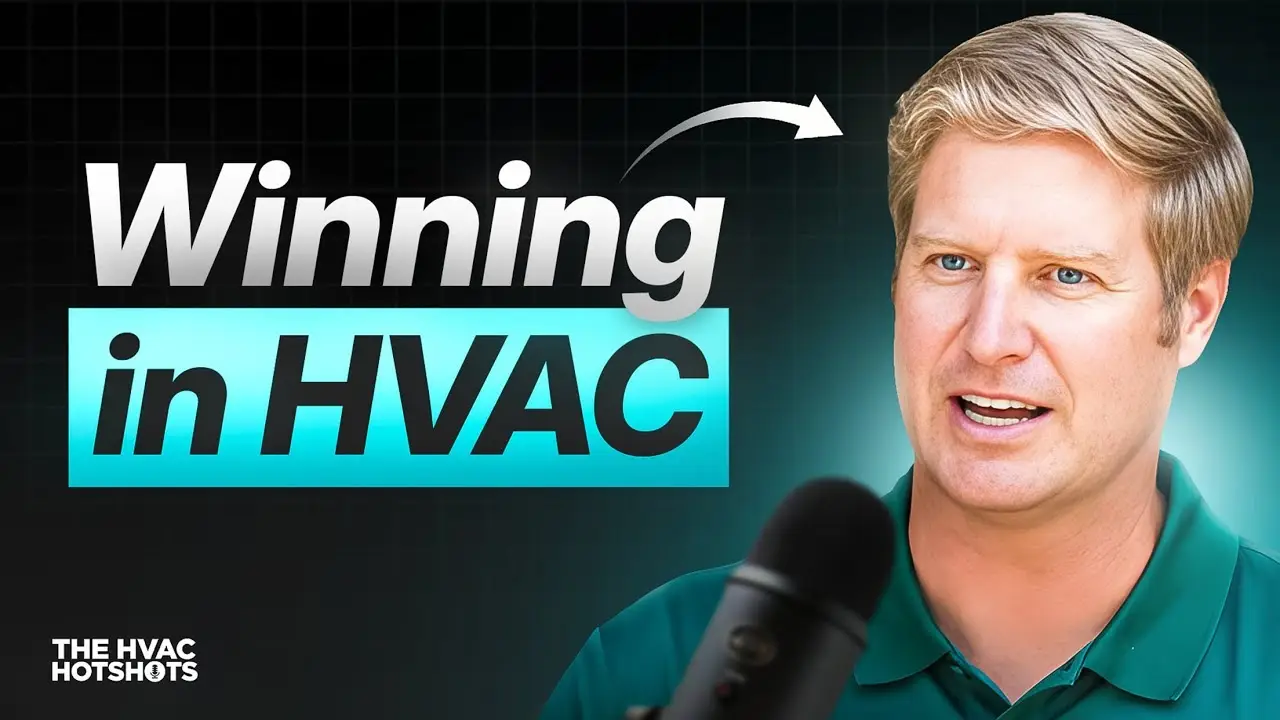
The Ultimate Cold Calling Playbook for HVAC Companies w/ Peter Roth
· Updated · Yash Singh
Peter Roth got into HVAC around 2017 knowing nothing about the industry, built and sold an HVAC company, and now builds and manages outbound call centers for home service businesses. In this episode of HVAC Hotshots, he makes the case for why HVAC operators should stop paying retail for shared leads and build their own outbound lead generation engine, covering data acquisition, the tuneup call structure, agent hiring from Latin America, and a cost model that typically pays back in month one.
Introduction
Peter Roth joined the HVAC industry in 2017 knowing almost nothing about how the equipment worked. His partner handled the field work; Peter built the sales and marketing side from scratch. After years owning and running the company, they sold it. He took what he had learned about outbound call centers and built a business around teaching and implementing the model for other home service operators.
His company is in the process of rebranding from Solar Wise to Scalify Call Centers, with a core focus on HVAC, roofing, and solar. In this episode, he explains why the call center model is one of the most underused lead generation strategies in the trades and how the economics work from day one.
Why Build an Outbound Call Center (The Economics of Exclusive Leads)
Most HVAC companies rely on some combination of shared lead platforms, Google ads, Facebook campaigns, and whatever organic inbound traffic they can generate. Peter’s core argument is that all of those channels have a structural problem that an outbound call center solves completely.
Shared leads: when a homeowner fills out a form on Angie or a similar platform, that form goes to multiple contractors simultaneously. You are not getting a lead. You are getting a chance to compete for a lead. “Why bother? Why are you messing around with something that is so built to work against you?”
Digital ads: when a homeowner clicks on your ad, they are almost immediately hit with dozens of other ads from your competitors. The moment they click, exclusivity evaporates. Google Ads and SEO are valuable, but Peter’s framing is direct: “Trying to solve the Google SEO algorithm is like wizardry. People have specialized and been doing it for decades and they still can’t figure it out, and when they do, Google changes it with the next update.”
An outbound call center solves both problems at once. Every appointment generated through it is exclusive to your company. You are calling homeowners, not competing against five other contractors on the same platform. And because the model is human-powered, scaling it is linear: add agents, add capacity. “Scaling is super easy. Scaling is real hard with other things.”
The financial case.
The comparison Peter makes is the most clarifying part of the conversation. If you wanted to buy a successful lead generation agency, you would pay somewhere between $250,000 and a million dollars or more. That is the market rate for a company that produces high-quality appointments consistently. A call center buildout through Peter starts at $15,000. His average client spends around $20,000. For that investment, you are getting a fully managed, operational lead generation system that you own.
Monthly operating cost for HVAC: as low as $5,000 to $6,000 all-in. That covers agents, management, software, and data. The payback period Peter promises: profitable in month one, at one-third of full operating capacity. Month two: two-thirds. Month three: full capacity. “That’s the worst case scenario. I’ve almost never seen it happen that way. It’s usually always better.”
The dialer Peter’s team uses is Ready Mode: $250 per seat, fully inclusive, covering all phone numbers used and all minutes. No additional costs.
The Data and the Call Structure That Actually Books Appointments
The most counterintuitive thing Peter says in the episode is about scripting: it is not about the words. “There’s nothing magical that anyone can say. Even if you hired Grant Cardone, there’s nothing magical he can say in five or six minutes that’s going to get a homeowner super excited.” The magic is in who you are calling.
Data acquisition is where Peter’s model differentiates. He has a team of 35 skip tracers in Pakistan whose job is to verify the accuracy of lead data: names, addresses, email addresses, and phone numbers. Skip tracing originated in real estate investing and refers to the process of confirming all data points before any call is made. The result is a hyper-targeted list of homeowners who match the profile of the right customer before the first dial.
“The same words that I say to an unqualified homeowner are going to fall flat versus if I say the same exact words to somebody who falls within my circle of the right type of homeowner I’m looking to target.” Targeting is the real work. The call is just the execution.
For HVAC, the primary targeting filter is simple: homes that are at least 10 years old, likely still on the original builder-installed system, probably starting to show problems. That homeowner is primed for a tuneup call before they even pick up the phone.
The tuneup call structure.
Cold calls have a tight window: 4-5 minutes minimum (shorter is not taken seriously), 6-7 minutes maximum (longer taxes the homeowner’s patience). Everything has to happen inside that window.
The approach Peter walks through is built around surfacing pain the homeowner may not have consciously acknowledged: “Hey, you may not know this, but homes that are 10 or more years old that have older systems like yours are probably suffering some serious efficiency problems at minimum. Even if your system is seemingly functioning today, are you aware that you’re probably overpaying on your electric bill by 20 to 30 percent? It’s kind of one of those hidden costs that you’re being penalized with right now that you may not be aware of. I’m happy to send someone out there to take a look. Maybe there’s nothing wrong with your system at all, and hopefully there isn’t. But would it be worth it to have someone come out for your own peace of mind? How does tomorrow afternoon look for you?”
Friendly. Non-threatening. Low commitment. Built entirely around the homeowner’s self-interest. “It all starts with building pain. It all starts with unearthing problems. No one buys anything unless they’ve got a problem we’re solving.”
What appointments actually cost.
In data alone, a booked appointment runs $20 to $40. Add in agent labor, software, and overhead, and the all-in cost per pre-booked in-home appointment is $50 to $90. Peter says he rarely sees it exceed $100 in any market. Even with a one-in-three close rate, the cost per acquisition is roughly $150. For any HVAC operator thinking about lifetime customer value, that number should be an obvious decision.
For operators who want to source their own data rather than use Peter’s team, the main third-party options are BatchData, PropStream, and PropWire, all of which charge 15 to 25 cents per record. Peter’s data runs 6 to 14 cents per record, skip traced and targeted. His advice to HVAC operators thinking about doing their own data scraping: do not. “I think you’re getting caught in the weeds. It’d be way more cost-effective to buy data that’s already been skip traced.”
One market per client is an absolute rule. Peter will not build two call centers in the same market because they would cannibalize each other. Every client gets exclusivity in their geography.
Hiring, Training, and Managing Remote Agents
The human side of a call center is the most important part. Peter is direct about this: “Who am I kidding? It’s the most important part. The human aspect of it.”
His primary recruiting market is Mexico. The reasons are straightforward: the best bang for the cost, at approximately $7 per hour. Fluency is non-negotiable: he only hires agents who test at a 10 out of 10 in English. Accent on a scale of 1 to 10 runs 1 to 2, which is barely perceptible. One in five Americans is Latino, so most homeowners are not going to register an accent at that level. “You’re getting American-quality labor at seven bucks an hour.”
Industry experience is prioritized over everything when possible. For HVAC specifically, Peter makes a comparison that puts the recruiting challenge in perspective: he also builds call centers for solar companies, and solar is dramatically harder to book than HVAC. “Everyone needs HVAC. You can’t go without your heating and cooling system. If you’re in Phoenix and your AC goes down, that’s a life or death situation. No one has ever woken up and said, ‘Oh my god, call the solar company.’ HVAC is a real thing. If it goes out, it’s got to be fixed now.” The urgency built into HVAC means agents with less HVAC experience can still perform well because the pitch is much easier to land.
Managing a distributed team.
Quality control across remote agents runs through two layers of management. Layer one: a dedicated full-time call center manager who is paid directly by the client. This person monitors calls, provides daily feedback, runs agent check-ins, and owns the day-to-day operation. Layer two: Peter’s team acts as account supervisors, overseeing the manager and coaching them on KPIs, systems, and standards. “It’s like hiring a dog trainer. You’re not training the dog, you’re training you. So we’re training the manager.”
The weekly performance review is a Zoom call with Peter’s team, the manager, and the client’s management. It covers 15 to 20 different metrics across agent performance, dialer performance, lead health, and call quality. Every client receives a weekly health report graded A through F.
Morale is treated as seriously as any operational metric. Remote agents are working from home, alone, making cold calls all day. Burnout is a real risk and once it sets in, performance drops quickly and is hard to recover. Peter builds a Slack workspace for every call center with channels for the management team, the agent team, and the c-suite level. “Everyone feels like they’re part of a community and no one gets lonely.”
When to Pull the Trigger
The right time to build a call center is almost anytime, with two conditions: the financial resources to do it and the operational capacity to handle the incoming appointments. Peter sees a recurring mistake where smaller companies get a call center built before they have enough sales reps to run the appointments. The influx comes in and the operation cannot service it. Get the operations side in order first.
If you have three to five sales reps who can handle appointment volume, a budget for the buildout, and a monthly operating budget around $5,000 to $6,000, the model works. The economics clear themselves in month one.
The broader point Peter closes with: a call center is transferable to any business you are in or ever will be in. “A call center is a call center is a call center. Change out the lead list, get agents who know the industry, modify the script. That’s it.” If you have plans to expand, diversify, or acquire another business, owning a call center means you already have the lead generation infrastructure ready to adapt.
FAQ
When does it make sense to build an outbound call center for an HVAC company?
Almost anytime, as long as two conditions are met: the financial budget for the buildout, and the operational capacity to handle the incoming appointments. If you do not have enough sales reps to run the appointments being booked, the model will produce opportunities you cannot service. Get the back-end operations in place first, then build the call center.
How much does an outbound call center cost to build and operate for an HVAC company?
The buildout starts at $15,000 and averages around $20,000 for a fully managed operation. Monthly operating costs for HVAC run as low as $5,000 to $6,000 all-in, covering agents, management, software, and data. Most clients see payback within the first month at one-third operating capacity, reaching full capacity by month three.
What does a booked in-home HVAC appointment cost through an outbound call center?
Data costs alone run $20 to $40 per booked appointment. Adding agent labor, software, and overhead brings the all-in cost to $50 to $90 per pre-booked in-home appointment. At a one-in-three close rate, that translates to roughly $150 per acquired customer.
Where does Peter recruit phone agents from, and how much do they cost?
The primary recruiting market is Mexico, where agents cost approximately $7 per hour. Only agents with 10 out of 10 English fluency are hired. Accent level runs 1 to 2 out of 10, which is barely perceptible to most American homeowners. Agents with existing HVAC industry experience are always prioritized.
What is the most common mistake HVAC operators make at the $3-5 million stage?
Staying in the business instead of working on it. At that scale, the owner is typically the bottleneck for every decision, running constant firefighting instead of building the systems that would prevent the fires. The shift that unlocks the next level is hiring management positions as investments, not expenses, and documenting every recurring problem as a standard operating procedure.
Want inbound calls alongside outbound? See Lead generation for HVAC companies.